Showing posts with label sugar. Show all posts

Wednesday, March 16, 2016

3d printed treats

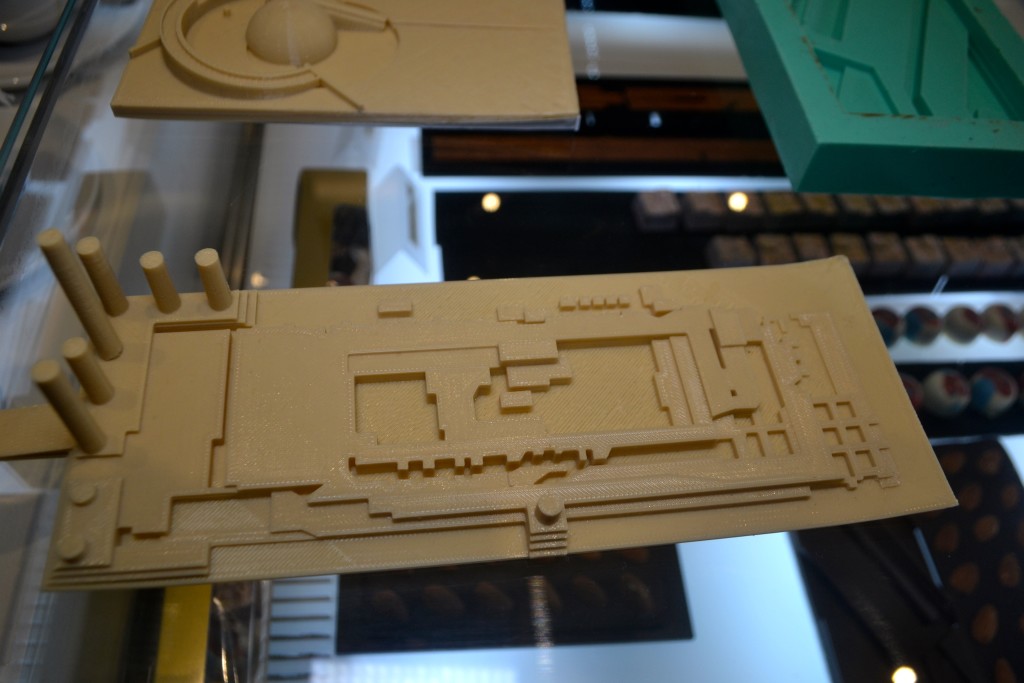
Not only does 3D printing open new creative doors in just about every industry, it also enables entrepreneurs to combine aspects of seemingly disparate industries into new and exciting businesses. Peter Zaharatos has spent his career working in the field of architecture, and he currently teaches the subject at New York City College of Technology. He’s a talented architectural designer whose skills have served him well in his chosen profession, but not long ago he decided to use those skills for an entirely different purpose. Last month, Zaharatos opened Sugarcube Dessert and Coffee, a gourmet café in Long Island City, New York. In addition to serving coffee, the café offers desserts that are nothing short of works of art.

LINK

Friday, November 27, 2015

16th century food porn

Though the contemporary phenomenon of food porn may feel like an Internet-era excess, there’s a long history of different cultures taking part in obnoxious public displays of meals. The Edible Monument: The Art of Food for Festivals, currently on display at the Getty Research Institute, considers the history of table decoration and food display in early modern Europe. The underlying message of these centuries-old examples feels echoed in contemporary TV cooking contests like Cake Wars or The Great British Baking Show: So much of eating is about spectatorship, about consuming feats of gastronomy with the eyes more so than the mouth. So lavish Pinterest planning and meticulous Instagram filtering of Thanksgiving dinner isn’t a corruption of the ages-old communal joys of eating—it’s a natural extension of it.

When it comes to party food especially, the sense of sight has always trumped the senses of taste. For Voltaire and other philosophes of the 18th century, taste was not a single sense but the act of discrimination in general, whether applied to painting or pastry. Its opposite was bad taste, or tastelessness. The meat mountains, fruit pyramids, and marzipan castles that graced princely and aristocratic tables from the 16th century onward may have pleased the palate, but they were primarily intended as feasts for the eyes: visibly expensive, fragile, and time-consuming to create, using hard-to-find ingredients like white sugar or out-of-season produce.

READ MORE

Tuesday, February 24, 2015

city = food


Visual Feast: If The World's Major Cities Were Made Of Food: 
Those global snacks and meals are the subject of a charming photo series called BrunchCity. In it, photographer Andrea G. Portoles and illustrator Bea Crespo reimagine the world's cities as mini metropolises where midday noshes are part of the architecture.

"We wanted to find a typical plate in each city that was easy to relate to," Portoles and Crespo write in an email. "For each city, we choose the most representative food or drink," they add.

READ MORE

LINK

Thursday, December 25, 2014

landmarks out of sugar

"They say imitation is the sincerest form of flattery. Thanks to food artist Caitlin Levin and her photographer collaborator Henry Hargreaves, imitation in candy is now undisputedly the reigning champion of the most sincere forms of flattery. The duo teamed up to reproduce a number of famous museums using one of the world’s favorite vices: sweets."

LINK

Monday, December 22, 2014

processed landscapes

"For their project "Processed Views," Barbara Ciurej and Lindsay Lochman used processed food to re-create famous landscape photographs that Carleton Watkins took of the American West. This "Fruit Loops Landscape" is based on Watkins' 1863 photo "Albion River.""

LINK

Sunday, December 14, 2014

Saturday, December 14, 2013

The Gingerbread House

The combination of food & shelter a Christmas tradition with the making of gingerbread houses. 
Records of honey cakes can be traced to ancient Rome. Food historians ratify that ginger has been seasoning foodstuffs and drinks since antiquity. It is believed gingerbread was first baked in Europe at the end of the 11th century, when returning crusaders brought back the custom of spicy bread from the Middle East. Ginger was not only tasty, it had properties that helped preserve the bread. According to the French legend, gingerbread was brought to Europe in 992 by the Armenian monk, later saint, Gregory of Nicopolis (Gregory Makar). Gingerbread, as we know it today, descends from Medieval European culinary traditions. Gingerbread was also shaped into different forms by monks in Franconia, Germany in the 13th century. Lebkuchen bakers are recorded as early as 1296 in Ulm and 1395 in Nuremberg. Nuremberg was recognized as the "Gingerbread Capital of the World" when in the 1600s the guild started to employ master bakers and skilled workers to create complicated works of art from gingerbread.Medieval bakers used carved boards to create elaborate designs. During the 13th century, the custom spread across Europe.Gingerbread figurines date back to the 15th century, and figural biscuit-making was practised in the 16th century. The first documented instance offigure-shaped gingerbread biscuits is from the court of Elizabeth I of England: she had gingerbread figures made in the likeness of some of her important guests.


The gingerbread bakers were gathered into professional baker guilds. In many European countries gingerbread bakers were a distinct component of the bakers' guild. Gingerbread baking developed into an acknowledged profession. In the 17th century only professional gingerbread bakers were permitted to bake gingerbread except at Christmas and Easter, when anyone was allowed to bake it.
The tradition of making decorated gingerbread houses started in Germany in the early 1800s. According to certain researchers, the first gingerbread houses were the result of the well-known Grimm's fairy tale "Hansel and Gretel", in which the two children abandoned in the forest found an edible house made of bread with sugar decorations. After this book was published, German bakers began baking ornamented fairy-tale houses of lebkuchen(gingerbread). These became popular during Christmas, a tradition that came to America with Pennsylvanian German immigrants. According to other food historians, the Grimm brothers were speaking about something that already existed. -- wikipiedia

Wednesday, December 4, 2013

Gingerbread Museums

The two food artists built recreations of 7 famous museums including the Guggenheim in New York, the Tate Modern in London, the Louvre in Paris, the Karuizawa Museum in Nagano, Museum Aan de Stroom in Antwerp, the Maxxi in Rome, and Museo Soumaya in Mexico City


Tuesday, October 22, 2013

HUNGER AND DECADENCE: CROQUEMBOUCHES


As part of the exhibition BEING , Storefront presents DISRUPT: Croquembouches, an installation-banquet on the connections and connotations between Food and Architecture. The event will follow a day-long installation by Savinien Carcostea, which includes five giant cones of Croquembouches, a traditional French dessert, that will be on display at Storefront's gallery throughout the day and will be offered to visitors from 6-7pm. 

The conversation will raise the points of contact between food and architecture: From the social and political connotations of what, how, and where we eat, to the similarities and differences of the research and distribution processes, to the performativity of the act of eating as a way of producing bubbles of negotiation. The conversation will include contribuitions by Jan Aman, Levan Asabashvili, Edward Eigen, and Yehuda Safran,  among others.

7,000 Croquembouches will be available for consumption.


HUNGER
According to City Harvest, 1.5 million New Yorkers are struggling against hunger. A new restaurant of refined decadence is always opening around the corner. 

DECADENCE
"The croquembouche, a pyramid of small cream puffs welded by caramel, inscribes itself in the tradition of classic French pastry as a decorative centerpiece. It is also a modular structure, and as such can be understood within a contemporary formal framework. Created by Antonin Carême, the celebrated early nineteenth century pastry chef who stated that “the most noble of all the arts is Architecture, and its greatest manifestation is the art of the pastry chef”, the croquembouche is in fact an avant-garde work of Architecture, both structural and spatial."
A historic construction somehow contemporary, a mixture of high cuisine, art, architecture, and cinema, the croquembouche is a disconcerting structure whose humorous appearance has long dismissed it as an outdated typology having no place outside of celebrations. Now is the time for the croquembouche to be celebrated." - Savinien Caracostea

About the artist
Savinien Caracostea has degrees in Architecture from the Harvard Graduate School of Design and Cornell University, a degree in Pastry Arts from the French Culinary Institute, and has extensive experience in film, photography, and graphic design. With an interest in cross-disciplinary spaces, events and publications, he consults and offers creative direction in Edible, Cinematic Architecture. For more, please visit www.savinien.com.